Why Hydraulic Flushing Is Critical?
Why Hydraulic Flushing Is Critical
Hydraulic systems are designed to operate with extremely tight tolerances. Modern pumps, proportional valves, servo valves and other precision components rely on clean hydraulic fluid to function correctly and achieve their expected service life.
However, contamination is introduced into almost every hydraulic system during fabrication, assembly and installation. Even when tubing appears clean from the outside, microscopic particles can remain inside the system and cause significant damage once the equipment is put into operation.
For this reason, hydraulic flushing is considered one of the most important steps before commissioning a hydraulic system.
What Causes Contamination in Hydraulic Systems?
Contamination can enter or be generated within a hydraulic system throughout its entire lifecycle.
During manufacturing and installation, contamination is commonly introduced through tube cutting, machining, bending, welding, assembly and handling. Metal particles, burrs, welding residues, dust, rust, sealing materials and other debris may remain inside the piping even when the system appears visually clean.
However, contamination does not stop once the system is commissioned.
Existing particles circulating in the hydraulic fluid cause wear on pumps, valves, cylinders and other precision components. This wear generates new particles, which continue to circulate through the system and create additional wear.
As a result, contamination is often a self-generating process. The more contamination present in the system, the more wear occurs. The more wear that occurs, the more contamination is generated.
Without proper flushing, filtration and cleanliness control, this process can accelerate rapidly and significantly reduce component life and system reliability.
Typical sources of contamination include:
- Tube cutting and machining
- Tube bending and fabrication
- Welding and assembly activities
- Installation and maintenance work
- Environmental contamination during storage or operation
- Component wear during system operation
- Seal wear and material degradation
- Pump, valve and actuator wear
For this reason, contamination should not be viewed as a one-time installation issue, but as an ongoing threat throughout the life of the hydraulic system.
What Happens If a Hydraulic System Is Not Flushed?
Once the system is commissioned, contamination is carried throughout the entire hydraulic circuit by the hydraulic fluid.
The consequences can include:
- Premature wear of pumps and motors
- Sticking or malfunctioning control valves
- Damage to proportional and servo valves
- Increased energy consumption
- Reduced system efficiency
- Damage to seals and sensitive components
- Unexpected downtime
- Increased maintenance costs
- Reduced equipment lifespan
In many cases, hydraulic component failures that appear to be mechanical problems are actually caused by contamination.
Why Are Modern Hydraulic Systems More Sensitive?
As hydraulic technology advances, component tolerances become increasingly smaller.
Modern hydraulic systems often operate at higher pressures, higher flow rates and tighter internal clearances than ever before. As a result, even microscopic contamination particles can create serious operational problems.
A particle that may pass harmlessly through a cylinder can cause significant damage when passing through a proportional valve or servo valve with extremely tight tolerances.
For this reason, equipment manufacturers and end users often specify strict cleanliness requirements before commissioning.
How Clean Should a Hydraulic System Be?
Cleanliness requirements vary depending on the application and the sensitivity of the equipment.
For hydraulic systems used in offshore, marine and demanding industrial applications, NAS 6 is commonly treated as the minimum acceptable cleanliness level before commissioning.
More sensitive systems, especially those equipped with proportional valves, servo valves or other precision hydraulic components, may require significantly cleaner oil. In such cases, the required cleanliness level can be NAS 4, NAS 3 or even cleaner, depending on the component manufacturer’s specification and project requirements.
| Application | Typical Cleanliness Requirement |
|————|——————————–|
| Standard Hydraulic Systems | NAS 6 |
| Standard Hydraulic Systems | NAS 6 or better |
| Systemer med proporsjonalventiler | NAS 4 – NAS 3 |
| Servo Valve / High-Precision Systems | NAS 3 – NAS 2 |
The required cleanliness level should always be confirmed against the project specification, component manufacturer requirements and commissioning procedure.
How Is Hydraulic Flushing Performed?
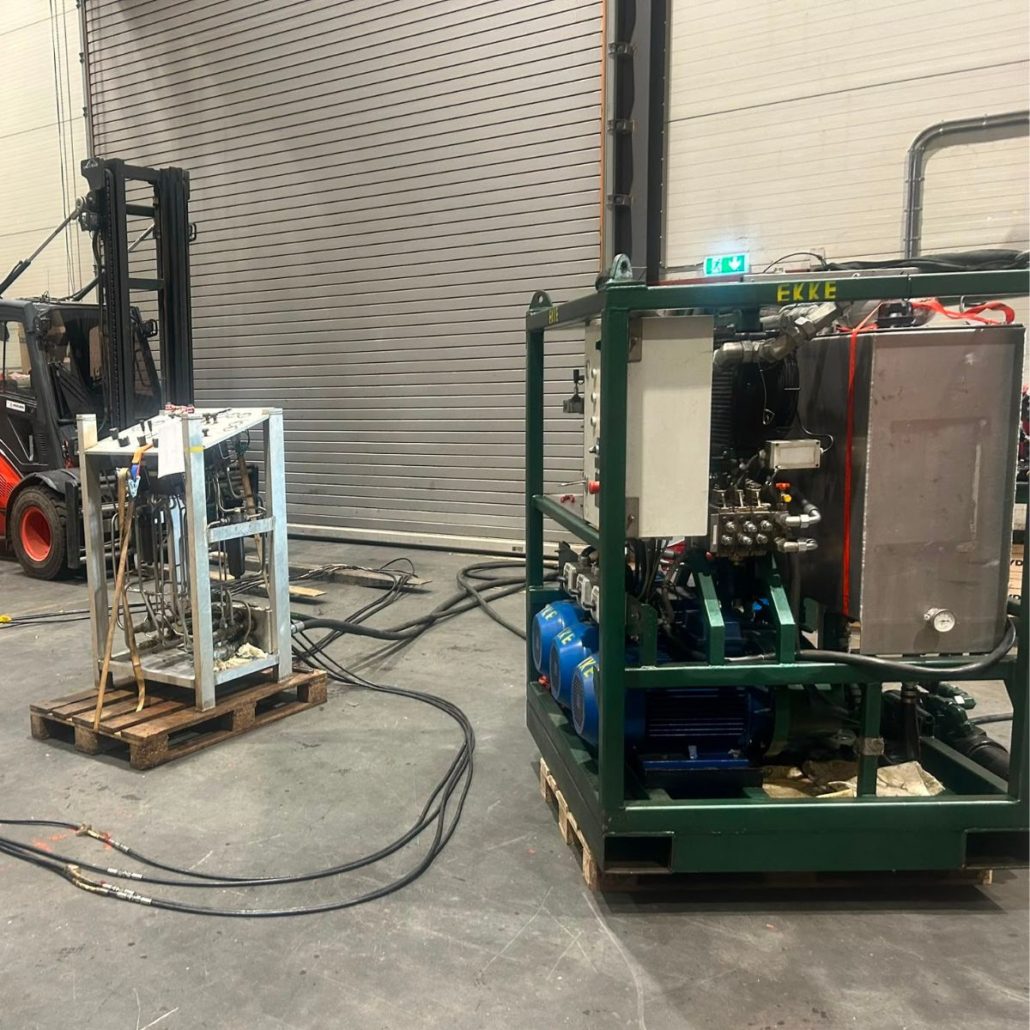
Professional flushing is far more than simply circulating oil through a system.
Many people believe that flushing performance depends only on flow rate. In reality, effective hydraulic flushing depends on the relationship between flow velocity, oil viscosity, oil temperature and pipe diameter.
To remove contamination effectively, the flushing process should achieve turbulent flow conditions. This is normally verified using the Reynolds number.
For hydraulic flushing applications, a Reynolds number above 4000 is typically considered the minimum requirement to achieve turbulent flow and generate the wall shear forces necessary to remove contamination from internal pipe surfaces.
A professional flushing process normally includes:
Turbulent Flushing
Effective hydraulic flushing requires more than high flow velocity.
The objective is to achieve turbulent flow throughout the system in order to generate sufficient wall shear stress to remove contamination from internal pipe surfaces.
Whether turbulent flow is achieved depends on several factors, including flow velocity, pipe diameter, oil viscosity and oil temperature.
For hydraulic flushing applications, the Reynolds number is commonly used to evaluate flow conditions. To ensure effective contaminant removal, the flushing process should typically achieve a Reynolds number above 4000.
By controlling flow rate, oil temperature and viscosity, the flushing process can be optimized to remove particles that would otherwise remain attached to internal surfaces.
Simply circulating oil through a system does not guarantee effective flushing. The correct flow conditions must be achieved to remove contamination and transport it to the filtration system.
Continuous Filtration
Specialized filtration equipment continuously removes contaminants from the circulating fluid.
Monitoring and Verification
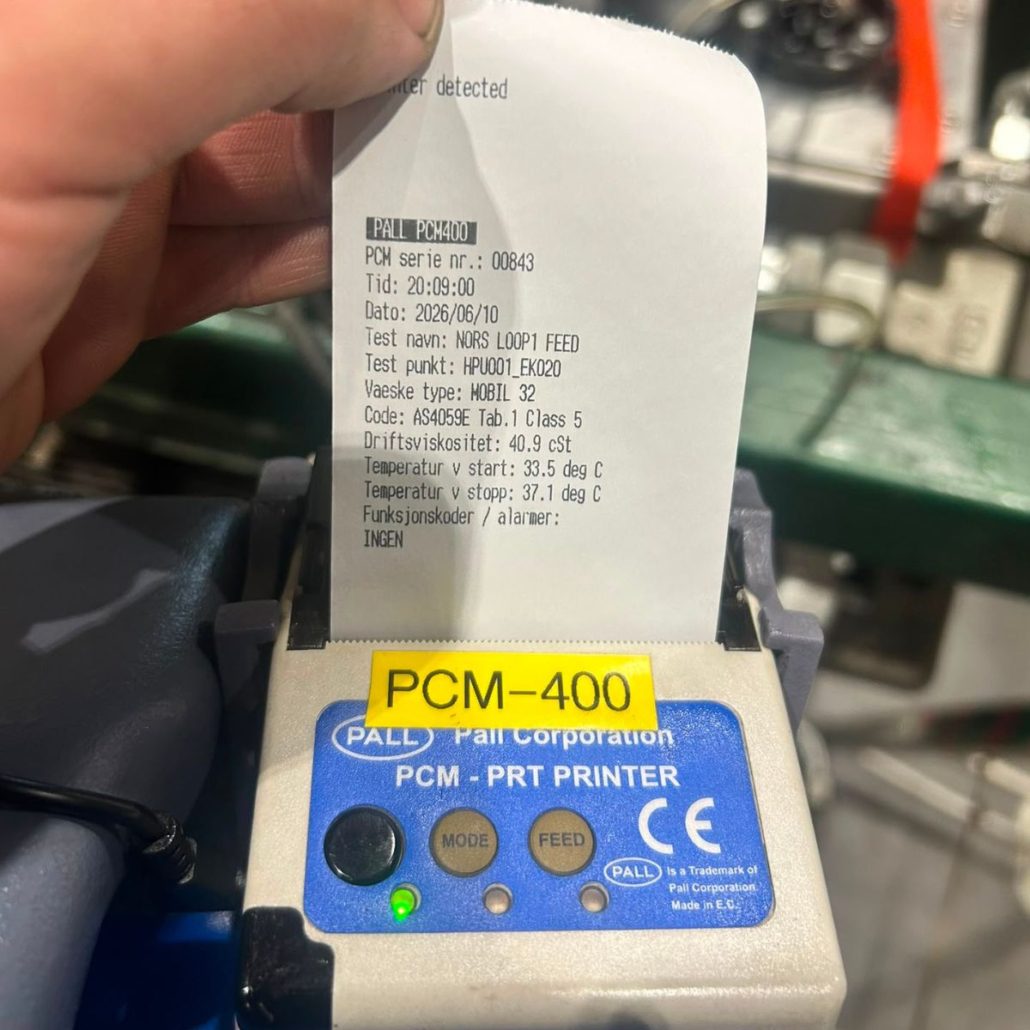
Calibrated particle counters are used to measure contamination levels throughout the flushing process.
Documentation
The achieved cleanliness level is documented and verified before the system is accepted for operation.
When Should Hydraulic Systems Be Flushed?
Hydraulic flushing is recommended in the following situations:
| Situation | Flushing Recommended |
|————|———————|
| New hydraulic installations | Yes |
| Offshore- og marine prosjekter | Ja |
| Major modifications | Yes |
| Pump replacement | Recommended |
| Valve replacement | Recommended |
| System contamination incidents | Essential |
Any activity that opens the hydraulic circuit introduces a risk of contamination and should be evaluated for flushing requirements.
Hydraulic Flushing for Offshore and Marine Applications
Offshore- og marine hydraulikksystemer opererer i krevende miljøer hvor pålitelighet er avgjørende.
Unexpected failures can result in:
- Production losses
- Vessel downtime
- Expensive repairs
- Safety risks
- Environmental consequences
For this reason, flushing and cleanliness verification are often mandatory requirements before handover and commissioning.
A properly executed flushing operation helps ensure that the hydraulic system starts its service life in the cleanest possible condition, reducing the risk of premature component failure and improving long-term reliability.
Can a new hydraulic system be commissioned without flushing?
Technically yes, but it is strongly discouraged. Even newly fabricated systems contain contamination introduced during manufacturing and installation.
How long does hydraulic flushing take?
The required flushing time depends on system volume, pipe dimensions, oil temperature, viscosity, filtration capacity and target cleanliness level. Some systems can be flushed within hours, while larger installations may require several days.
How is cleanliness verified?
Cleanliness is verified using calibrated particle counting equipment. The achieved cleanliness level is documented and reported according to NAS 1638 or project-specific requirements
What NAS cleanliness level is normally required?
For most offshore and industrial hydraulic systems, NAS 6 is considered the minimum acceptable cleanliness level before commissioning.
Systems equipped with proportional valves, servo valves and other high-precision hydraulic components often require significantly cleaner oil, typically NAS 4 to NAS 2 depending on manufacturer specifications and project requirements.
Is flushing worth the cost?
In most cases, the cost of flushing is only a small fraction of the cost of replacing a damaged pump, servo valve or other critical hydraulic component.
Conclusion
Hydraulic flushing is not simply a maintenance activity. It is a critical engineering process that directly affects system reliability, component life and operating costs.
By removing contamination before commissioning and verifying the achieved cleanliness level, hydraulic systems can operate more efficiently, experience fewer failures and deliver a longer service life.
Contamination creates wear, and wear creates more contamination.
A hydraulic system is only as reliable as its cleanliness level.
Need professional hydraulic flushing, particle counting or cleanliness verification?
Ekke Hydraulics provides hydraulic flushing, pressure testing, particle counting and cleanliness verification for offshore, marine and industrial applications throughout Norway.
Contact us to discuss your project.
///////
This post is also available in: